
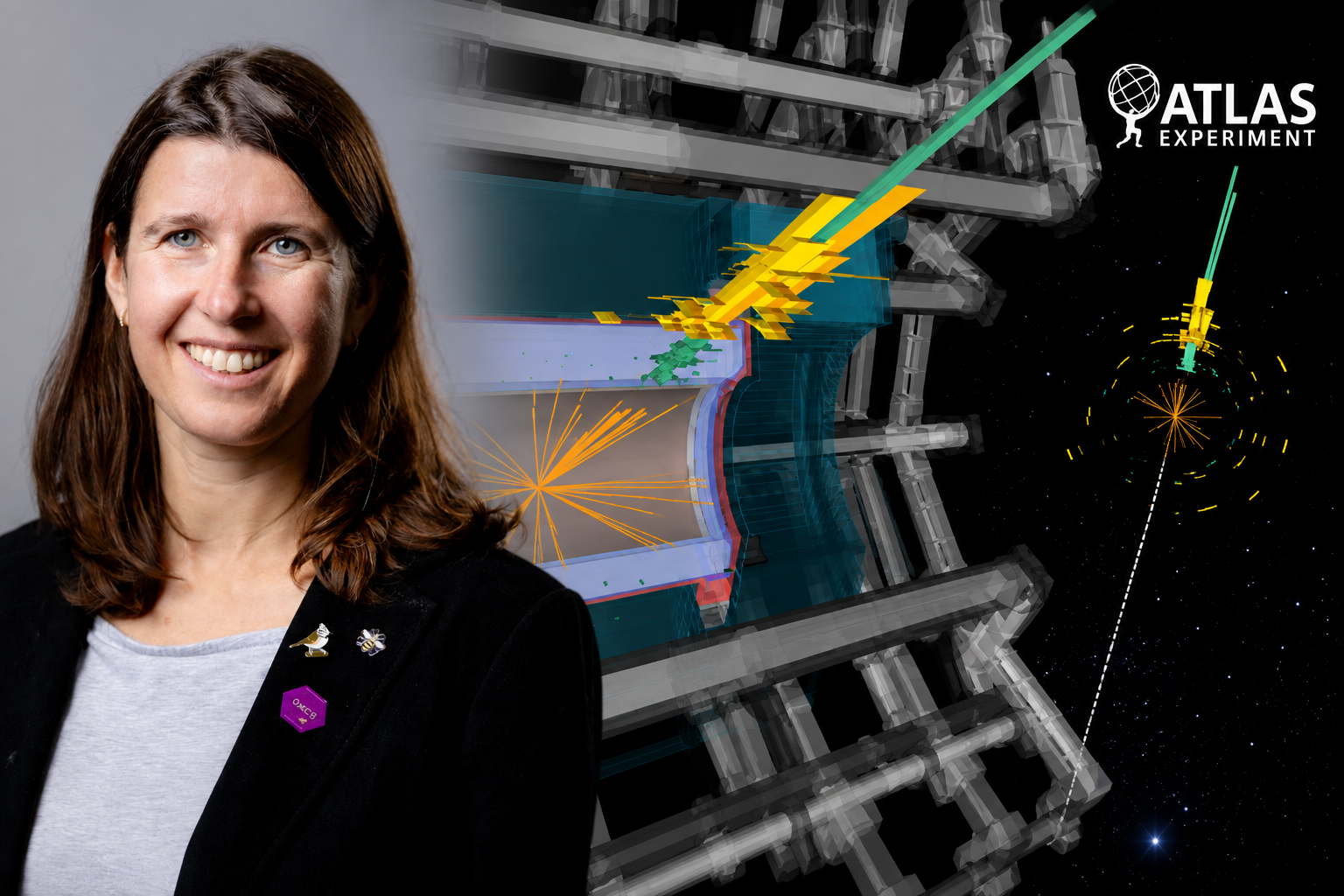
Professor Caterina Doglioni: Ghosts in the cosmos: hunting for dark matter
Saturday, 31st October 2026 • Hebden Bridge Town Hall
What better way for the Lit & Sci to celebrate Halloween than by exploring something that really is invisible?
On Halloween night, Professor Caterina Doglioni will take us into the mysterious world of dark matter, the unseen substance that makes up about 85% of all matter in the Universe, yet neither emits nor reflects light and has so far escaped direct observation.
We know dark matter is there because of its gravitational effects, from the unexpectedly high speeds at which stars and gas move around galaxies to the way matter shapes the large-scale structure of the cosmos. But despite decades of evidence, scientists still do not know what dark matter is actually made of.
Uncovering its nature remains one of the biggest unanswered questions in modern physics.
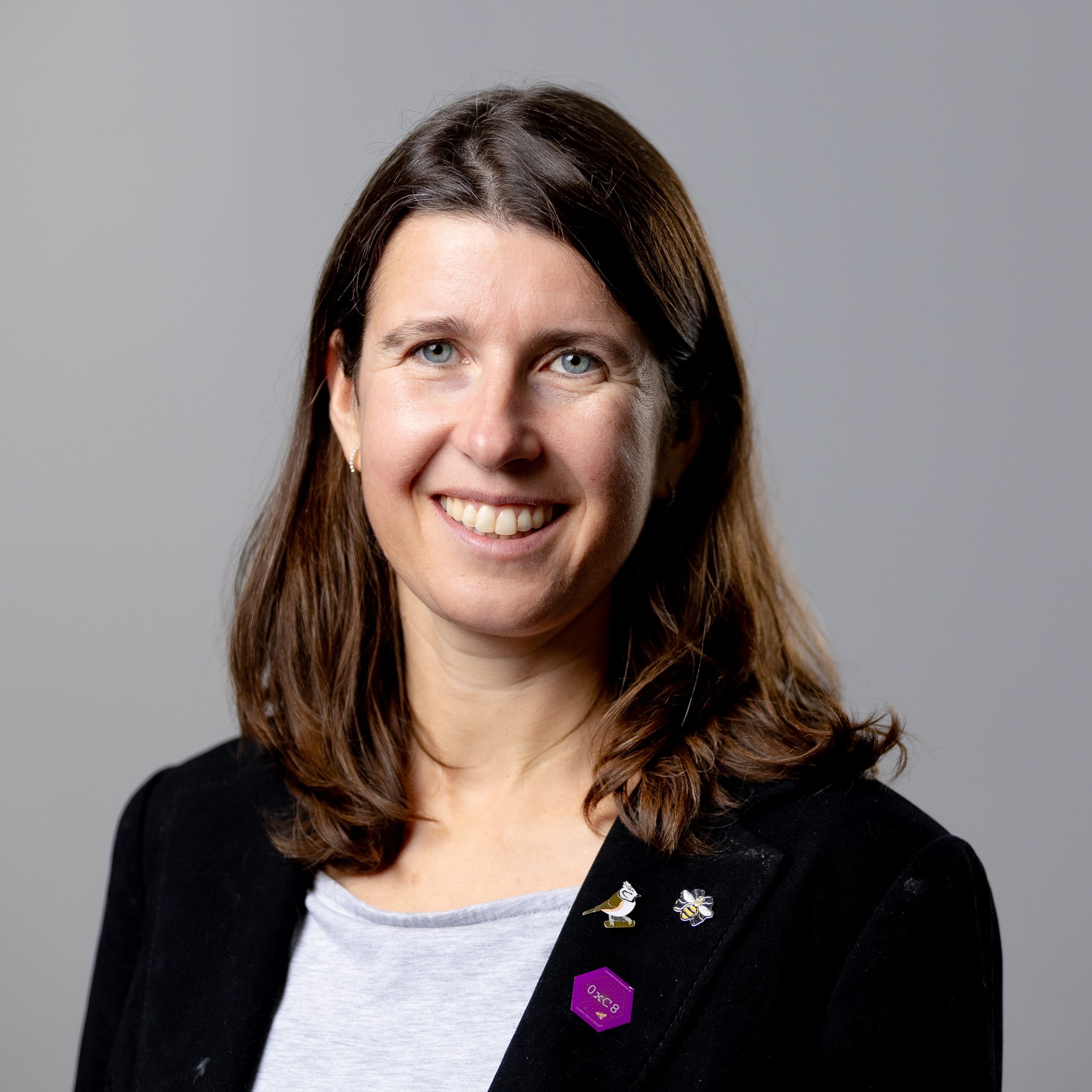
Professor Caterina Doglioni
Caterina is Professor of Particle Physics at the University of Manchester, working in the same Department of Physics and Astronomy as Professor Brian Cox.
After completing her PhD at Oxford working on the ATLAS experiment at the Large Hadron Collider, Caterina developed a particular interest in physics beyond what we currently know, especially the physics of dark matter. Her research explores both the known and unknown constituents of matter and the extraordinary experimental and computational challenges involved in studying them.
At CERN, scientists are attempting to create dark matter under controlled conditions at the Large Hadron Collider and identify it through the subtle effects it might leave behind in particle detectors.
Caterina will introduce us to this remarkable search and explain how researchers are dealing with the enormous quantities of data produced by modern particle physics. She will also explore how advanced computational techniques and artificial intelligence are being used to search for extremely rare processes that could help reveal what dark matter really is.
Following in the footsteps of Professor Tim O’Brien of Jodrell Bank, who spoke to the Lit & Sci in 2023 and is a colleague of Caterina’s at the University of Manchester, this promises to be an accessible journey into some of the deepest questions in modern science.
What is the Universe made of? Why is so much of it invisible to us? And could we finally be getting closer to finding the answer?
Write-up by Roger Gill
Ghosts in the Cosmos: Hunting for Dark Matter
Professor Caterina Doglioni, Hebden Bridge Literary & Scientific Society
There cannot be many occasions when a spinning top, billiard balls and Halloween ghosts all feature in a lecture about the mysteries of the universe. But Professor Caterina Doglioni, a particle physicist who, among other things, works on the ATLAS project at CERN, managed to bring them together in a fascinating evening that left her very attentive audience with considerably more questions than answers.
And that, perhaps, was the point.
Caterina helped us realise that dark matter exists because of its gravitational effects, yet nobody knows what it actually is. She used a spinning top to explain how astronomers discovered that stars towards the outer edges of galaxies were moving much faster than expected. Something invisible must be exerting an additional gravitational pull. Dark matter also distorts space-time, bending light as it travels across the universe, enabling scientists to map something they cannot see.
And then there is the sheer quantity of the stuff. Of all the matter in the universe, only about 15% is ordinary matter – everything from the stars and planets to the chairs we were sitting on. The remaining 85% is dark matter, which nobody has yet directly detected or identified. And that is before we even consider dark energy, which accounts for approximately 68% of the universe’s total mass-energy.
A video took us back to the beginning of the universe, when everything was an extraordinarily hot soup of particles and radiation. After some 380,000 years, the universe had cooled sufficiently for light to travel freely. But it would be millions more years before the first stars appeared. During those long cosmic dark ages, dark matter was already helping to create the gravitational structures from which galaxies would eventually emerge.
By this stage, I suspect many of us were beginning to realise just how little we knew about the universe we inhabit. How, then, do scientists investigate something they cannot see?
At CERN’s Large Hadron Collider, protons are smashed together at enormous energies, producing showers of particles. Caterina used the idea of billiard balls to explain how scientists might detect an invisible particle through the momentum apparently missing after a collision. Could that missing particle be dark matter? Possibly, but it might equally be something already familiar, such as a neutrino.
The scale of all this is quite astonishing. Billions of collisions, unimaginable quantities of data and a worldwide network of scientists and computers searching for evidence of something that might have escaped detection. Artificial intelligence is increasingly important in this work, although Caterina also emphasised the responsibility to make such research more efficient and environmentally sustainable.
As it was Halloween, ghosts made an appearance too, providing an entertaining way of considering particles that pass through ordinary matter almost unnoticed, and the possibility that invisible particles might interact with one another.
The questions afterwards covered the Higgs boson, quantum computing, time travel and the puzzle of why matter survived its encounters with anti-matter. Of course, someone had to ask when we might finally know what dark matter is. Understandably, Caterina could not give us a date to put in our diaries!
What made the evening so memorable was not simply the extraordinary science, but Caterina’s enthusiasm for explaining it. We left knowing a lot more about dark matter than most of us knew before, but perhaps even more about how much of our universe remains to be discovered.
Our chair summed the evening up by saying what a privilege it was to listen to Caterina. Our wholehearted applause showed that we thoroughly agreed.
Past Speakers
Saturday, 31st October 2026 • Hebden Bridge Town Hall

Saturday, 3rd October 2026 • Hebden Bridge Town Hall

Tuesday, 26th May 2026 • Hebden Bridge Town Hall

Saturday, 14th March 2026 • Hebden Bridge Town Hall

Saturday, 21st February 2026 • Hebden Bridge Town Hall

Pam Warhurst CBE: From Seeds to solutions. Incredible Edible, how it all began and where it’s going.
Saturday, 17th January 2026 • Hebden Bridge Town Hall

Saturday, 29th November 2025 • Hebden Bridge Town Hall

Saturday 27th September 2025 • Hebden Bridge Town Hall

Saturday 11th January 2025 • Hebden Bridge Town Hall


Saturday 26th October 2024 • Hebden Bridge Town Hall

Saturday 28th September 2024 • Hebden Bridge Town Hall

Saturday 9th March 2024 • Hebden Bridge Town Hall

Saturday 17th February 2024 • Hebden Bridge Town Hall

Saturday 20th January 2024 • Hebden Bridge Town Hall

Saturday 28th October 2023 • Hebden Bridge Town Hall

Saturday 25th November 2023 • Hebden Bridge Town Hall

Saturday 30th September 2023 • Hebden Bridge Town Hall

Friday 14th July 2023 • Hebden Bridge Town Hall

Saturday 18th March 2023 • Hebden Bridge Town Hall

Saturday 25th February 2023 • Hebden Bridge Town Hall

Saturday 21st January 2023 • Hebden Bridge Town Hall

Saturday 3rd December 2022 • Hebden Bridge Town Hall

Saturday 12th November 2022 • Hebden Bridge Town Hall

Saturday 8th October 2022 • Hebden Bridge Town Hall

Saturday 12th March 2021 • Hebden Bridge Town Hall

Saturday 12th February 2021 • Hebden Bridge Town Hall


Saturday 24th November 2018 • Hebden Bridge Town Hall

